




Finding the Rhythm: Teaching Behavior & Academics the HLP Way
by Elizabeth Auguste, Ph.D. and Alexis Swanson, Ed.D.
During this school year, the TTAC team at William & Mary has been focusing our Link Lines articles on the four domains of the High Leverage Practices (HLPs). Though these evidence-based practices are integral to planning specially designed instruction that meets the unique needs of students with disabilities, they are for all teachers to use in the general education classroom as they benefit all students. This issue of Link Lines focuses on the domain of Instruction in Behavior and Academics, a broad range of practices that highlight ‘what to teach’ and ‘how to teach’ for both functional and academic skill growth and mastery.

_________________________

By LaShauna Britt, M.Ed.
Why use HLP GPT?
In December of 2025, HLP GPT, an AI partnership, was announced by the Collaboration for Effective Educator Development, Accountability, and Reform (CEEDAR) Center. The purpose of this AI partnership is to help embed high leverage practices (HLPs) into daily teaching.
What problem does this solve?
Educators often know what good instruction should look like but struggle to enact it, especially when teaching diverse learners, including students with disabilities. HLPs require planning, real-time instructional decision-making, and the consistent use of evidence-based strategies. HLP GPT helps bridge the gap between theory and day-to-day classroom practice by translating HLPs into actionable, classroom-ready guidance.
Who is it for?
- General and special educators
- Pre-service teachers learning to design effective instruction
- Instructional coaches and mentors
- Teacher educators supporting candidates with HLP implementation
- School leaders supporting inclusive instruction
If you teach students with varied learning needs and want instruction that genuinely works for all learners, this tool is for you.
What is it?
HLP GPT is an interactive, educator-focused coaching tool designed to support the implementation of HLPs. It functions like a just-in-time instructional coach, helping educators plan, refine, and reflect on instruction aligned to the HLPs.
What’s inside?
- Plain-language explanations of HLPs (e.g., explicit instruction, flexible grouping, meaningful feedback, use of assessment data)
- Classroom examples tailored to content areas, grade levels, and student needs
- Scaffolds for lesson planning, modeling, guided practice, and checks for understanding
- Supports for adapting instruction for students with disabilities while maintaining high expectations
- Reflective prompts and coaching questions to strengthen instructional decision-making
Why is it worth using?
- Practical and efficient: Saves time by turning HLPs into concrete instructional moves you can use immediately
- Inclusive by design: Keeps students with disabilities at the center of instructional planning without separating them from high-quality core instruction
- Confidence-building: Helps educators feel more prepared and intentional when implementing these practices
- Aligned to evidence: Grounded in the HLP framework used in teacher preparation, coaching, and evaluation
Bottom line: HLP GPT helps educators move from knowing HLPs to using them effectively, so instruction is more precise, more responsive, and more impactful for every learner.
https://ceedar.education.ufl.edu/high-leverage-practices/
_________________________

Facilitating High-Quality Specially Designed Instruction
by Cathy Buyrn M.Ed.
In real estate, the name of the game is location-location-location. In education, the name of the game is instruction-instruction-instruction. Instructional leaders at the building and division level know that the most critical role they play is the facilitation of high-quality instruction for all students. High-quality instruction at Tier 1 is the front line for students with disabilities, but they also require specially designed instruction (SDI) that focuses on their unique needs (IDEA, 2004). It is not sufficient to provide grade level content instruction without addressing the strengths and needs in a student’s Individualized Education Program (IEP).
Special education teachers’ primary responsibility is to develop and deliver SDI, as opposed to helping students to complete every single assignment from the general education teacher. While completion of some general education assignments might be appropriate for a student with a disability, the priority for the special education teacher is always SDI associated with IEP goals focused on a student’s needs that will help them progress in the general education curriculum (Buyrn, 2024).
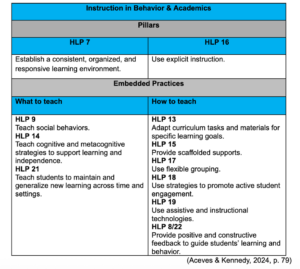
Students might require SDI in both behavior and academics. The focus of this edition of Link Lines is the High-Leverage Practice (HLP) instructional domain (Aceves & Kennedy, 2024; see Table 1). The Instruction in Behavior and Academics domain is where special education happens. Without strategic and individualized SDI, students with disabilities are not receiving the services for which they are entitled.
Table 1
High-Leverage Practice Instructional Domain
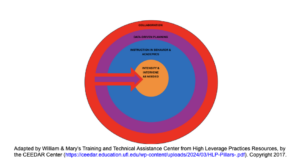
It is not possible to achieve high-quality instructional goals in behavior and academics without a solid foundation provided by the HLP domains of Collaboration and Data-Driven Planning. Figure 1 depicts the interaction and connection between the HLP domains. Effective school leaders can facilitate high-quality instruction in behavior and academics by making sure that educators are effectively communicating and using specific student data throughout the school year. SDI is not a scripted delivery of content-related goals. SDI is developed and delivered on a day-to-day basis guided by student responsiveness to instruction. Special educators and general educators must work collaboratively to determine what to teach and how to teach each student based on needs and goals identified in the IEP.
Figure 1
Integrated High-Leverage Practice Domains
Beninghof (2022, p. 48) offers a seven-step planning process for SDI that school leaders can use as a model for responsive instructional planning in behavior and academics.
Planning for SDI
- Clarify the learning target.
- Pinpoint difficult moments.
- Choose IEP goals to address.
- Identify the metacognitive processes.
- Adapt the general approach.
- Attend to access skills.
- Boost participation.
School leaders need to understand that these seven steps involve complex analyses of student needs and instructional design skills. Special education teachers must be provided with the conditions that allow them to engage in rich reflection and planning to accomplish the goals of high-quality SDI. If teachers lack the training, support, time, or resources to engage in these complex tasks, outcomes for students will be limited.
The CEEDAR Center at the University of Florida has developed updated HLP Leadership Guides to support the supervision and facilitation of the HLPs. Inclusive educational practices for instruction in behavior and academics can be explored through the pillar practice guides for HLPs 7 (Establish consistent, organized, and responsive learning environments.) and 16 (Use explicit instruction.). These leadership guides are aligned to the 2024 HLP framework and provide a good starting point for conversations with teachers about high-quality SDI. It should be noted that these guides are not just a list of tasks to assign to teachers. They include actions and reflections for school leaders so that they can create productive learning and practice conditions for teachers.
School leaders can access professional development and coaching supports at the High-Leverage Practices website, the IRIS Center, CEC, and CEEDAR Center. School leaders in Virginia can also request assistance from their regional Training and Technical Assistance Centers (TTACs) with professional learning and coaching focused on improving outcomes for students with disabilities through the HLPs.
References
Aceves, T. C. & Kennedy, M. J. (Eds.). (2024). High-leverage practices for students with disabilities (2nd ed.). Council for Exceptional Children and CEEDAR Center.
Beninghof, A. M. (2022). Specially designed instruction: Increasing success for students with disabilities. Routledge.
Buyrn, C. A. (2024, September). Planning for progress: Specially designed instruction. Link Lines Administrators’ Corner. T/TAC William & Mary. https://ttaclinklines.pages.wm.edu/link-lines-september-2024/
Collaboration for Effective Educator Development, Accountability, and Reform (CEEDAR) Center. (2026). High-leverage practices for students with disabilities leadership guides. https://ceedar.education.ufl.edu/hlp-leadership-guides/
Individuals with Disabilities Education Act, 20 U.S.C. § 1400 et seq. (2004). https://sites.ed.gov/idea/statute-chapter-33