




 When Data Speaks Clearly: Visualizing Data to Drive Action Across the High-Leverage Practices
By Mackenzie Turbeville-McCorry, Ed.D. & Kara McCulloch, M.S.
Do any of these feel familiar? As part of the school improvement team, you’ve been tasked with reducing referrals in the hallway. You’ve implemented a new transition routine and the next task is to determine how effective it’s been. As the discussion begins, everyone seems to have a different opinion and some of those are voiced very strongly.

___________

AI Considerations Packet
by Jason Betzner, M.Ed.
At TTAC W&M, we are engaging special educators in responsible and ethical use of artificial intelligence (AI) in the workplace. In October 2025 and January 2026, we welcomed one-hundred educators and administrators to the School of Education to explore the new frontier of AI in special education.
Through breakout sessions and panel discussions, participants combined their expertise to develop some considerations. These are compiled in our AI Considerations Packet. This considerations packet is a living document that will be updated as new information, guidance, and resources emerge.
The packet highlights ways AI can support planning and student learning. In addition, it provides guidance on current best practices to make sure AI is being used in the most ethical, unbiased, and safe way possible. There are links to resources as well. When you’re ready, explore the packet and reach out to TTAC for coaching and support!
______________

Intensify and Intervene in Behavior and Academics: When at First You Don’t Succeed
by Cathy Buyrn M.Ed.
Inclusive school leaders understand that teaching and learning are trial-and-error processes that can frustrate teachers and students. The frantic pace of the school year and testing calendars can lead to panic and feelings of failure. No one performs well under those conditions. School leaders can create conditions that help teachers and students take struggles in stride and approach those struggles with a calm assurance (Tschannen-Moran & Tschannen-Moran, 2010) that allows for regrouping as part of the natural teaching and learning processes.
In the same way that teachers can set a tone of calmness around behavior and academics for students, school leaders can set the same tone for teachers who are stressed out about high stakes accountability and limited progress for certain groups of students. Students with disabilities are frequently among those student groups with limited progress. Unfortunately, the way some teachers deal with limited progress is to lower expectations and accept limited outcomes. School leaders need to model that sense of calm, high expectations for all students, and curiosity focused on applying the scientific method to teaching and learning.
The Link Lines Administrators Corner explored the application of the scientific method to teaching and learning in the September 2025 edition (Building Data Literacy & Progress Monitoring Skills) and expanded on that application in March 2026 (Facilitating High-Quality Specially Designed Instruction). While this same approach applies to intensifying and intervening when students struggle with initial attempts at mastery, school leaders can offer a more explicit process to target specific skills for students with disabilities.
The National Center on Intensive Intervention (NCII) at The American Institute for Research (AIR) has developed a Data-Based Individualization (DBI) process that leaders and teachers can utilize when students do not respond to validated interventions (see Figure 1). The process provides a method for adjusting instruction for “students who are not making adequate progress in their current intervention program, are not meeting Individualized Education Program (IEP) goals, have persistently low academic achievement, have high intensity/frequency behavior” (NCII, 2026, para. 4).
Figure 1
Data-Based Individualization Steps
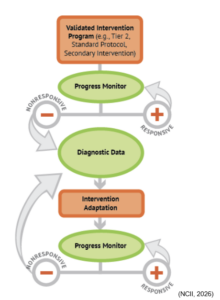
The DBI process acknowledges that students with disabilities have a unique combination of characteristics and needs and may not always respond to initial attempts at instruction. School leaders who create an environment of calm assurance when these predictable challenges arise by “assisting teachers to respond to life’s experiences without catastrophizing” (Tschannen-Moran & Tschannen-Moran, 2010, p. 44) will be able to facilitate improved outcomes for students with disabilities in behavior and academics.
A critical component of the DBI process is hypothesis generation focused on student response to individualized instruction. Hypothesis generation gives educators an opportunity to reflect on the possible reasons a student has not responded to previous instruction. NCII (2019a) offers clarifying questions and considerations that can be used to develop and refine an actionable hypothesis to inform instructional adjustments. These resources help focus conversations so that leaders and teachers can make sense of the data available and plan for effective intervention. The questions center on intervention design, intervention delivery/fidelity, and learner needs and background (NCII, 2019a). Once a fully formed hypothesis has been developed, leaders and teachers can use the Taxonomy of Intervention Intensity (Fuchs et al., 2017 as cited in NCII, 2019b) to adjust strength, dosage, alignment, transfer, comprehensiveness, and behavioral and academic supports.
It is important that school leaders set the bar high for all students and make the learning environment a safe place for strategic trial-and-error when students do not respond to interventions. The High-Leverage Practices (HLPs) (Aceves & Kennedy, 2024) provide the foundational skills and practices that support effective intervention for students with disabilities across levels of need. Leaders and teachers who are versed in the HLP domains (i.e., collaboration, data-driven planning, instruction in behavior and academics, intensify and intervene as needed) are well positioned to improve outcomes for all students. When school leaders provide training and support with a sense of calm and curiosity (Tschannen-Moran & Tschannen-Moran, 2010), teachers are free to experiment and strategically adjust their instruction to meet the diverse needs of all learners. Learning environments grounded in curiosity and efficacy for teachers result in greater levels of student engagement, motivation, and progress (Tschannen-Moran, 2014).
As educators we must all approach our important work with the belief that “there is no such thing as an acceptable failure rate” (Zumeta, 2014, 1:10). Utilizing the HLPs along with the DBI process gives teachers a structured approach to problem solving when students are not responding to instruction. Giving up on students is not an option. When given the appropriate tools, school leaders can facilitate problem solving so that teachers can meet the challenge of the age old saying, “if at first you don’t succeed, try, try again” (Palmer, 1840, p. 223). It should come as no surprise that this enduring quote on the importance of perseverance came from an early teaching manual. While much has changed in the world of education, a commitment to perseverance should still guide our efforts with all students regardless of their challenges.
School leaders can access additional professional development resources and tools focused on intensive interventions at the Center on Multi-Tiered Systems of Support website to develop the skills and knowledge of individual teachers and teacher teams. In Virginia, leaders can also reach out to their regional Training & Technical Assistance Center (TTAC) for support.
References
Aceves, T. C., & Kennedy, M. J. (Eds.). (2024). High-leverage practices for students with disabilities (2nd ed.). Council for Exceptional Children and CEEDAR Center.
National Center on Intensive Intervention. (2019a). Clarifying questions to create a hypothesis. https://intensiveintervention.org/resource/clarifying-questions-create-hypothesis
National Center on Intensive Intervention. (2019b). What is the taxonomy of intervention intensity? https://intensiveintervention.org/implementation-intervention/taxonomy-intervention-intensity
National Center on Intensive Intervention. (2026). What is data-based individualization? https://intensiveintervention.org/data-based-individualization
Palmer, T. H. (1840). The teacher’s manual: Being an exposition of an efficient and economical system of education, suited to the wants of a free people. Marsh, Capen, Lyon, & Webb. https://play.google.com/store/books/details?id=hSABAAAAYAAJ&rdid=book-hSABAAAAYAAJ&rdot=1&pli=1
Tschannen-Moran, B., & Tschannen-Moran, M. (2010). Evocative coaching: Transforming schools one conversation at a time. Jossey Bass.
Tschannen-Moran, M. (2014). Trust matters: Leadership for successful schools (2nd ed.). Jossey Bass.
Zumeta, R. (2014, July 25). Long story short: Why is intensive intervention critical for students with disabilities? [Video] YouTube. https://www.youtube.com/watch?v=PXicrmJ6HB4&t=21s